


Differences Between CMMS/GMAO and EAM (Industrial Asset Management) Software
In many production plants, the problem is not a lack of effort from the maintenance team. The problem is something else: increasingly complex operations are still being managed with tools that are no longer sufficient. Scattered work orders, spare parts purchased urgently, incomplete records, technicians resolving incidents without real traceability, and maintenance managers forced to make critical decisions without a consolidated view of the asset, its cost, and its impact on production.
This is where a question arises that many companies ask too late: do we need a CMMS, or do we already need an EAM system?
The confusion is understandable. Both systems are related to maintenance and assets. Both help digitalize processes. Both can manage work orders, preventive maintenance plans, historical records, inventories, and reports. But they are not the same, and making the wrong choice can lead to two costly mistakes: implementing a tool that is too basic for the actual complexity of the plant, or implementing a platform that is too extensive for an organization that is not yet ready to take full advantage of it.
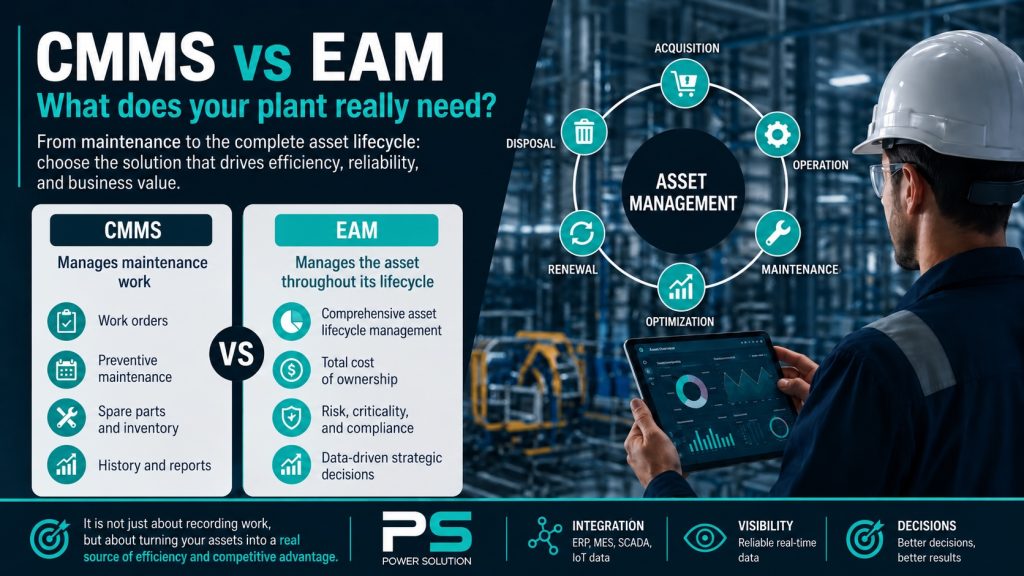
In simple terms, a CMMS focuses on managing maintenance work. Enterprise Asset Management focuses on Asset Management and the asset’s entire lifecycle. That difference may seem subtle, but it completely changes the conversation.
The starting point: managing work is not the same as managing assets
A CMMS is built around a very clear logic: organizing maintenance management. Its core revolves around work orders, notifications, preventive maintenance plans, spare parts, inspections, and tracking completed work. It is a tool designed to answer questions such as:
- What maintenance needs to be performed?
- Who needs to do it?
- When is the task due?
- Which spare parts were used?
- How long did the technician take?
- How many failures has this piece of equipment experienced?
That already provides significant value. In fact, for many plants that still work with Excel, paper, or poorly connected systems, implementing good management software represents a major step forward: more organization, more discipline, greater traceability, better preventive maintenance compliance, and better day-to-day control.
But as the organization matures, that layer starts to become insufficient.
Because in an industrial plant, an asset matters for more than just the work it generates. It matters because of its economic, operational, and strategic impact. It is not enough to know that a pump underwent three interventions or that a line accumulated ten corrective actions. What matters is understanding whether those enterprise assets are consuming too much budget, whether it makes sense to keep repairing them or replace them, how they affect plant availability, whether they are reducing OEE, whether they are causing excessive spare-parts inventory, whether they are generating deferred CAPEX, or whether they are compromising safety, quality, or regulatory compliance.
This is where an EAM system comes in.
What does an EAM really do, and why does it go beyond maintenance?
Enterprise Asset Management (EAM) is not limited to organizing maintenance tasks. Its scope is broader: it provides comprehensive management of the asset as a business resource throughout its entire lifecycle, from acquisition and installation through operation, maintenance, optimization, renewal, and retirement.
In other words, EAM changes the question. It is no longer only about “what work do I need to do?” but rather “what should I do so this asset has a longer service life, lower total cost, greater availability, higher reliability, and a better contribution to the business?”
This change in approach has very specific implications.
EAM software makes it possible to connect maintenance with other key areas such as operations, purchasing, inventory, finance, compliance, engineering, and even production. That is why it is often integrated with ERP, MES, SCADA, Internet of Things systems, and analytics platforms. The reason is simple: if a company wants to implement true Asset Management, it cannot view assets solely from the maintenance workshop. It must also view them from the perspective of cost, risk, production, and strategy at an enterprise level.
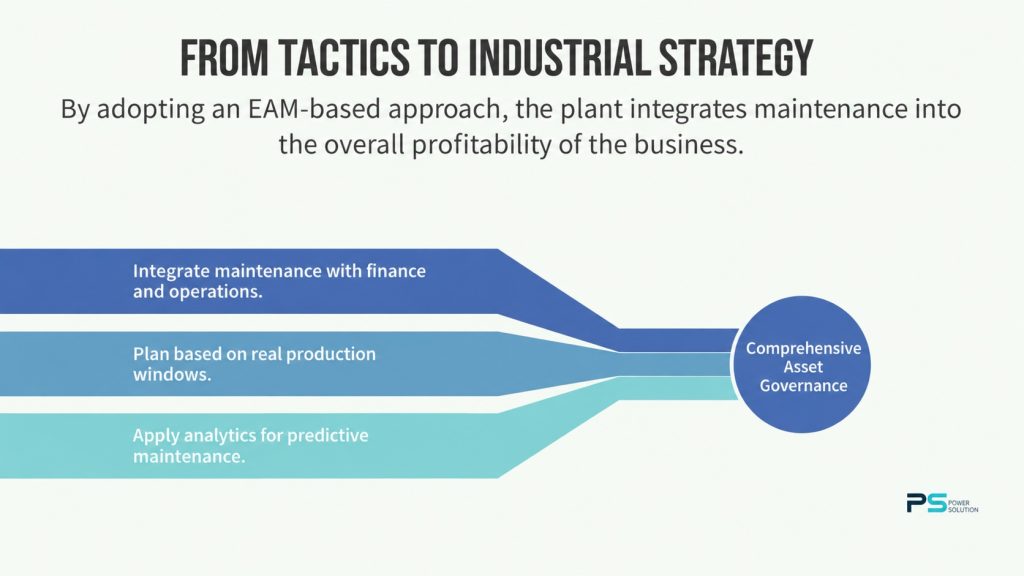
That is why, when an organization adopts an EAM approach, it starts working with concepts such as:
- asset lifecycle
- total cost of ownership
- criticality and execution risks
- asset history and lifecycle record
- maintenance planning based on actual production windows
- integration with inventory, purchasing, and finance
- predictive maintenance and advanced analytics
- data-driven renewal or replacement decisions
The most important difference: the economic approach to the asset
One of the most relevant differences between a CMMS and an EAM is that EAM incorporates the economic dimension of the asset much more strongly.
A CMMS can help you see how much a repair cost or how many labor hours were dedicated to a work order. An EAM, by contrast, takes the conversation to a higher level within Enterprise Asset Management: how much is this asset costing us throughout its lifecycle? Are we over-repairing it? Are we making panic purchases? Do we have spare parts sitting idle in the warehouse because of reactive maintenance decisions? Are we extending the equipment’s life correctly, or are we simply patching failures?
In a production plant, these are not minor questions. Often, the highest cost is not the failure itself, but all the operating costs surrounding it:
- urgent purchases at worse prices
- excess inventory caused by fear of running out of spare parts
- unplanned downtime caused by reactive maintenance
- lost production and lower productivity levels
- missed delivery commitments
- deterioration in OEE
- higher cost per unit produced
- premature asset wear
- premature CAPEX replacements
This is where EAM provides a decisive advantage: it turns Asset Management into a business conversation.
CMMS: when it is the right solution
Not every plant needs to start with an EAM. In fact, in many cases, doing so would be a mistake.
A CMMS is the right option when the organization’s immediate priority is to organize and professionalize maintenance management. For example, when the company needs to:
- digitalize work orders
- plan preventive maintenance programs
- record failures and interventions
- control spare parts and consumables
- improve response times
- reduce the negative impact of poor industrial management
- provide mobility tools for field technicians
- maintain basic but reliable traceability
- eliminate paper, scattered emails, and disconnected Excel spreadsheets
- start measuring maintenance KPIs consistently
It is also a good decision when the organization does not yet have the internal maturity, data quality, or cross-departmental structure needed to take full advantage of EAM software.
Put simply: if your plant does not yet have a reliable asset record, properly executed preventive maintenance, and basic control over technical work, you probably need well-implemented management software before adopting an oversized EAM.
EAM software: when your plant needs to take the next step
An EAM system starts to become necessary when the plant stops viewing maintenance as an isolated function and begins applying asset management as part of overall profitability.
This is especially true when several of the following conditions apply:
- the plant has many critical physical assets
- several areas, such as energy operations or utilities, need to work under the same framework
- maintenance directly affects production, quality, and compliance
- the company wants to use integrated software to connect maintenance with ERP, purchasing, or finance
- lifecycle management needs to be planned according to the production plan
- the company wants to move from preventive to predictive maintenance
- sensors, SCADA integrations, or operational data are available
- investments, replacements, or CAPEX need to be justified with data
- the organization wants to measure total cost of ownership
- the objective is to improve lifecycle, availability, and reliability, not simply close work orders
In this context, EAM stops being “just another tool” and becomes an industrial asset management system for governing the plant.
What changes in practice inside a production plant
The difference between a CMMS and an EAM is easier to understand when applied to the reality of the plant. With a CMMS, the maintenance manager can see that a packaging machine experienced five failures this quarter, that its preventive maintenance tasks were completed, and that the technician spent a certain number of hours resolving incidents.
With an EAM, in addition to all of that, the manager can carry out lifecycle management to understand whether that packaging machine:
- is consuming more spare parts than reasonable
- is repeatedly causing urgent purchases
- is compromising the production plan and productivity levels
- has an increasing cost relative to its operational potential value
- should be serviced during a window coordinated with MES or production through effective operations control
- requires sensors or analytics supported by Artificial Intelligence
- is reaching a point where replacing it makes more sense than continuing to repair it
In other words, EAM makes it possible to move from tactical work management to strategic Asset Management.
Integrations: a decisive boundary
Another key criterion when deciding between CMMS and EAM is the level of integration the plant requires. If the main need is within maintenance, a CMMS may be sufficient. But if the company wants to connect maintenance with the rest of the operational and business ecosystem, the conversation changes and requires a connectivity-driven approach.
An EAM reaches its full potential when it uses software solutions to connect with:
- ERP, to understand purchasing, costs, budgets, and the financial traceability of the asset.
- MES, to plan lifecycle management according to actual production rather than “when there is time.”
- SCADA or OT systems, to capture operational signals and move toward a condition-based approach.
- IoT and sensors, to monitor critical variables and feed data management.
- Analytics or BI tools, to make better use of management data and turn it into decisions.
In process industries or continuous manufacturing, this integrated software capability is not a luxury. It is a requirement for moving beyond traditional maintenance.
USEFUL CONTENT: How Implementing IBM Maximo Asset Management Software Eliminates Hidden Costs
Which results are usually seen first?
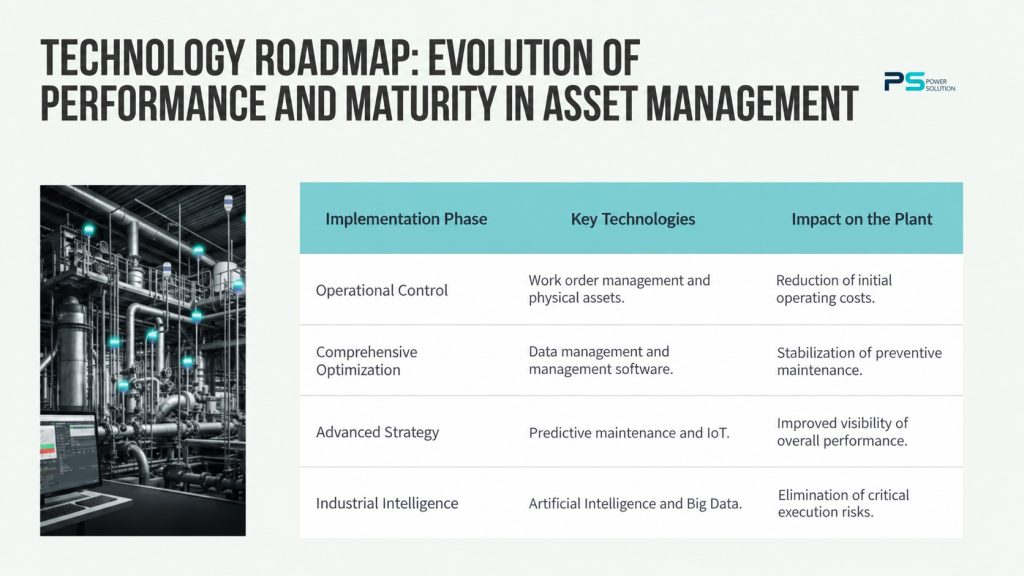
A common mistake when implementing these platforms is talking too early about Artificial Intelligence, advanced analytics, or digital twins when the plant is still trying to solve much more basic problems. The reality is that companies first buy control, then efficiency, and only later intelligence through proper data management.
The first tangible results after successfully implementing industrial asset management software are usually the following:
Within the first 3 months The dominant feeling is usually greater control. The company begins to gain visibility into:
- the actual inventory of enterprise assets
- centralized historical records
- work traceability across maintenance teams
- visibility into technicians and tasks
- less administrative chaos
- better preventive maintenance tracking
- less dependence on people’s memory
Between 3 and 6 months More visible operational improvements begin to appear in Asset Management:
- fewer impulsive spare-parts purchases
- better stock control
- better response times
- higher productivity among technical personnel
- better preventive maintenance compliance
- gradual reduction in avoidable reactive maintenance
Between 6 and 12 months The organization begins using data to make better decisions by following best practices:
- prioritization based on criticality and execution risks
- more realistic lifecycle management planning
- progressive transition from corrective to preventive and then predictive maintenance
- maintenance decisions based on historical data
- reduction in over-maintenance
- improvements in availability and reliability
- greater ability to justify future investments
When implementation reaches more advanced lifecycle stages, it becomes possible to discuss broader impacts: OEE, TCO, CAPEX deferral, reduction in unplanned downtime, inventory optimization, and longer asset lifecycles.
So, what does your plant really need?
The right answer does not depend on trends or acronyms. It depends on the actual complexity of your physical assets, the maturity of your organization, and the objective you are pursuing to improve productivity levels.
You need a CMMS if your priority is to organize maintenance, digitalize daily work, improve operational discipline, and create a reliable data foundation.
You need an EAM if your plant, whether in energy operations or manufacturing, understands that maintenance cannot be managed separately from cost, production, reliability, risk, and investment strategy.
Put another way:
- If you want to manage work better, start with a CMMS.
- If you want to manage enterprise assets more effectively as a critical business resource, you need an EAM.
The key is not only the technology: it is how it is implemented
There is an uncomfortable truth here: many implementations fail not because of the software, but because the company was never clear about what it wanted to achieve with it.
If an organization implements a platform simply for compliance, due to corporate pressure, or to digitalize “because it is expected,” data quality quickly deteriorates, adoption drops, and the system ends up underused. By contrast, when the plant understands lifecycle management, defines objectives, and aligns processes, the system begins to generate real value.
That is why the choice between CMMS and EAM should not begin by asking only about features. It should begin with much more strategic Asset Management questions:
- Which decisions are we unable to make today because we lack information?
- Are we managing maintenance, or are we managing the asset lifecycle?
- Do we only want to record work, or do we want to improve service life, cost, and performance visibility?
- Is our priority operational discipline or comprehensive asset governance?
- Are we ready to integrate maintenance with production, purchasing, inventory, and finance?
Conclusion
CMMS and EAM are not competitors. They are different answers to different levels of need within Asset Management. A CMMS handles maintenance management very effectively. EAM expands that vision to manage the asset across all lifecycle stages, integrating operations, cost, risk, and strategy.
For a production plant, making the right choice is not about buying the “most complete” platform, but the one that truly fits its current situation and the level of performance visibility it wants to build.
At POWER SOLUTION, we understand that the decision is not purely technological. It is operational, economic, and cultural. That is why, before discussing management software, it is essential to understand the plant’s context, maintenance maturity, asset criticality, and the level of integration the business requires.
Because digitalizing work orders is one thing. Turning assets into a real source of efficiency, reliability, and operational advantage through excellent Asset Management is something very different.
Do you believe your plant has already reached the level of maturity required to move from basic maintenance management to a comprehensive asset strategy?
Contact one of our advisors and we will help you choose the right solution to maximize the performance of your assets.